Showing posts with label Current affairs. Show all posts

Tuesday, 23 December 2014

Serial Podcast!


If you haven’t heard about this podcast called Serial, where have you been? Probably living your normal life, not overly investing in or obsessing over a random radio, non-fiction story. Serial is a 12-episode podcast about a murder case that occurred in 1999 in Baltimore. 


I’m not one to jump on the bandwagon of popular culture fads. I only just bought a Macbook, didn’t get a Netflix subscription till a couple of months ago and refused to read Twilight. I prefer to wait till I am good and ready to sample such things, when the hype dies down. Serial Podcast was no exception, I was told about it by my friend a couple of months ago, didn’t really understand the premise and it slipped my mind.

It wasn’t until a couple of weeks ago when another friend talked about it that I downloaded an episode on my phone using her home WIFI (I don’t have unlimited data ok) before heading home on the tube. I was instantly hooked and had a great four days of getting to work being enthralled by the real life story. I listened to 11 episodes in four days of binging. The last episode was released last week.

What is a podcast?
A podcast is a downloadable broadcast that can be listened to on the go. This medium has been around for a while but since October 2014 This American Life (a weekly non fiction podcast) launched its spin off podcast show called Serial. This show has become the most popular podcast ever with over five million iTunes downloads.

What’s the story with serial?
Serial is based on a 1999 murder case of an 18-year-old High School Student, Hae Min Lee who was strangled allegedly by her ex boyfriend Adnan Syed. Syed now facing life imprisonment has always professed his innocence, with scanty to no forensic evidence linking him to the crime Sarah Koenig sets out to talk to as many people involved in the case as she can to find answers.

Koenig works with a team but is the narrator, reporter and producer to the 12-part series.  She tries to tell the tale from a variety of perspectives, has regular recorded telephone meetings with Syed, the star and only witness on the prosecution side - Jay, and other students who attended the Baltimore High school. Every episode focuses on a different aspect, the trial, Syed’s Lawyer, his alibi etc. Koenig and her team read reports and pore through evidence. This results in well researched, thoughtful and enlightening episodes. Listeners get the chance to be completely taken in, absorbed by the true life story and are invited try and find out who did it.


Newspaper Cutting


Similar to Orange is the New Black
Serial reminds me of Orange is the New Black, tenuous but stick with me.  Both are true stories about crime, both a very popular, both investigate the harsh realities system, possible injustices and the wide ranging consequences of it. OITNB released in the UK in May 2013 is based on the memoirs of Piper Kerman who spent a year in prison after being convicted of drug smuggling charges. However, the hit Netflix show is controlled in some part by the creator of the memoirs, Kerman herself. She wrote her story, was guilty of the crime and admitted it and is now well known for it. Kerman is in control of how the story is told and how she is portrayed. In contrast, those involved in the Baltimore murder case are not in control neither is the accused, Syed and his family and friends.


Criticisms of the show
While many have hailed Serial as a pioneering series, original reporting, a great narrative; many also have been critical of the show for various reasons.

  1. The victim, Hae Lee is never really focused on. Not really Koening’s fault, she contacted her family several times to try and get their input into the show but to no avail. But I can understand why this is a sticking point.
  2.  It’s a real, true life event that occurred. It is because this is real, things get a bit tricky, the friends and family of Hae and Adnan are exposed. This awful thing is being dragged up all over again and it must be frightening and upsetting. Some people may think it’s an example of some sort of misery porn, obsessing over a ‘who dunnit’.
  3. It has racial stereotyping in it. Some people have criticised Koening’s musings saying that it has a lot of racial stereotyping. The good immigrants being Syed being described as too innocent looking to be a killer and Hae of Korean descent described as popular and intelligent. Jay – an African American Adnan’s acquaintance was described with a surprise, he liked alternative music, not hip-hop and even played Lacrosse! I think there is some evidence of this, but I don’t think this is an overall indictment of the show.
  4.  Crazy fans. The fans of the show have gone crazy over it, flocking to the Best Buy shop which is where Syed allegedly called his friend Jay after the murder occurred. 

Conclusion
I think the series is incredible, instantly engaging and thoughtfully reported. Koening and her team have spent  over a year researching this case mainly because she believes that the accused is a nice guy. Having been approached by a family friend of Syed’s to investigate the case she tries her best to be impartial, fair and transparent. She openly is unapologetic for expressing her voice in her reporting, evidence of reflexivity is clear. The show encourages people to think about memories, friends, family and death. With the end of this series, goodness knows what I’m going to do with my time- I’ll probably get over it and reluctantly move on to the next fad.


Monday, 1 December 2014

Stepping on top of people just for a bargain? Black Friday is here to stay

Black Friday is a long standing American tradition. But what is it and how did it get to the UK shores?


What is Black Friday?
Black Friday is a day of mass sales and consumerism in America, often charted as the start of the holiday shopping season. The event occurs on the Friday after Thanksgiving (which falls on the last Thursday of November). Bargain hunters go forth and seek out deals after stuffing their gobs with turkey. Retailers such as Best Buy, Walmart and online shops all slash their prices in the hope of cashing in and making large profits.

What is  behind it?
Black Friday has its roots in 1950s Philadelphia. Apparently local police officers started to use the term to describe the busy streets and the smog created by traffic of people flocking to watch a local Army vs Navy American Football game. In the 1980s television stations and advertisers used the day to attract shoppers out on this holiday and spend their cash.

Contrary to what has been circulating though social media recently the tradition has nothing to do with slavery and has nothing to do with slave traders selling slaves at discounted prices. Some believe the term has come from the time in the year that shops make profit and move from the red (loss making) to the black (profit making).

Why is it here?
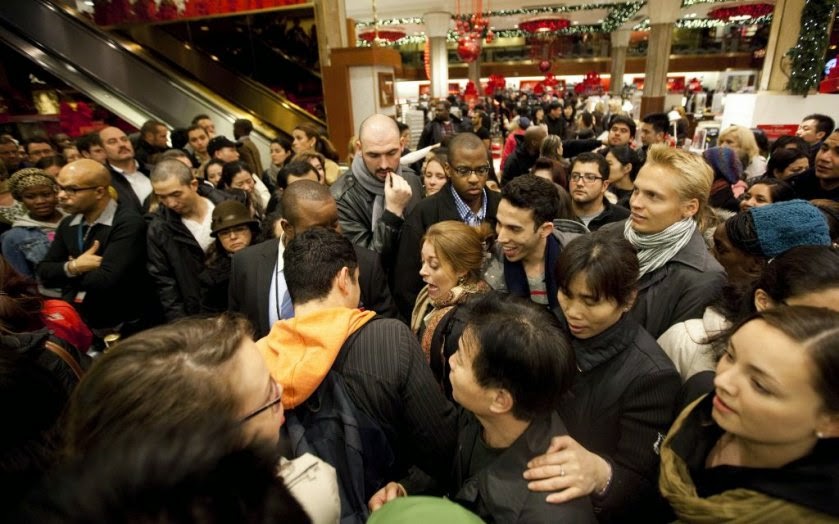
Black Friday is characterised by long queues, early starts and sometimes scenes of hysteria and violence. Black Friday was brought to the UK by Amazon and Asda in 2010, since then more and more retailers have adopted the practice. The main reason why this has been absorbed by retailers across the pond is that businesses can smell the pound signs. 2013 saw the day come into its own in the UK, charting big sales for many retailers.

A downside to all of this bargain hunting is that it sometimes causes crazy scenes of not very British like queueing and madness. Some shops opened at 12 midnight with flocks of people lining up, literally stepping on and over each other to get that marked down plasma screen TV.


Getty Images

These scenes are not what people are used to in this country.  With reports of retailers like ASOS inflating their costs in the run up to the day and then offering 30% discounts, leaving prices sometimes higher than the original ones, some people are less than happy.

Who cares?
Some people feel that the day promotes mass consumerism and greed. I'm a lover of bargains myself however, queueing, fighting and loosing sleep over some apparent lower priced goods is not really how I like to spend my time. Jumping on the discount bandwagon doesn't really make sense to me especially when it hasn't been made relevant to this audience. As Brits don't celebrate Thanksgiving, having the day after it as some kind of sales paradise is slightly strange.

What's more, if retailers are seeing this as an excuse to hoodwink and trick consumers into thinking they are getting a bargain when they are not, then i'm definitely not a fan.  Unfortunately Black Friday does look like it's here to stay so lets hope next years affair is a bit more civilised? I doubt it.

Thursday, 23 January 2014

Benefits Street: excellent documentary or poverty porn?


Channel 4 has another reality TV show, expose, documentary.  Move over My big Fat Gypsy Wedding, Benefits Street is the new kid on the block. The documentary makers from Channel 4 spent over a year filming on a street in Winson Green, Birmingham UK where it claims the majority of over 99 inhabitants on James Turner Street are claiming government benefits.  

Many people have criticised the show as 'poverty porn', a way for us "have somes" can stare and jeer at the Dickensian style baddies, draining the state of all of our hard working money. The episodes focus on different themes, episode 1 introduced some main characters of the street, including white Dee, a matriarch of the street whipping everyone into shape and black Dee a woman on the verge of eviction and frustrated at the lack of employment opportunities. 

The episode was also extremely controversial as it depicted a just released from Jail Danny and his junkie friend Fungi on an expedition to find loot to sell for drugs. It showed Danny creating an alarm proof bag and depicted him breaking the security tag for the stolen goods on a bus. Episode 2 showed the cultural mix on the street by featuring a group of Romanians entrepreneurially trying to make ends meet by selling scrap metal much to the dismay of other residents annoyed at the mess this caused.

The show is an interesting depiction of a modern street with problems, but these issues are not so different from those in wealthier, middle class neighborhoods such as: unemployment, absent fathers, immigration, integration, drug abuse and crime. These issues are not just social ills of the less fortunate, they occur in normal people too, just behind closed doors. The show shows a street where people can group together, help each other out. Struggling heroin addict Fungi could always call on white Dee to help him with his benefits claims and hold money for him.  

                                 
Episode 1 showed a gentleman Smoggy who offered basic amenities such as soap, milk and hot chocolate all for 50p. He noticed that many people including himself were struggling and took advantage of a gap on the market. Since the show aired he has been offered three jobs. Some people have said the show portrays a negative image of people on benefits. I know people who live on benefits and they don't live like this. I also spent 3 years living in Birmingham and didn't see evidence "scroungers". People who claim benefits are everywhere, in every city and town in the UK. What the show does do is shows its perspective of what some people on benefits go through and what they face.  


The show has had some major criticism, incensing conservative MPs to use the show as political fodder, cries of child exploitation, claims of poverty porn. I think I understand what the show is trying to do, show people on benefits and how day to day life is for them warts and all, but does it go too far? One thing that is portrayed is the community spirit people helping each other out like an episode of Eastenders, but maybe they should all go and just get a job.

Wednesday, 24 July 2013

The case of Trayvon Martin


This case has sparked national and international protests and exposed parts of America's laws. In February 2012 George Zimmerman, a neighbourhood watch man of a gated community in Florida shot Trayvon in an alleged act of self defence. In the trail which culminated earlier this month, (July 2013), the Jury acquitted Zimmerman of manslaughter and second degree murder.


The background
George Zimmerman is a 29 year old man who was part of the local neighbourhood watch programme in the twin lakes area (a gated community) in Florida. The area had reported some burglaries in the year hence why the neighbourhood watch committee had been set up.  On the day of the shooting, Zimmerman reported spotting a black youth around the estate, looking 'suspicious'. This person was in fact Trayvon Martin, a 17 year old boy visiting his dad and step mother at his step mothers  house. After Zimmerman calling the police and relaying what he had seen, he still pursued Martin. An altercation occurred which ended in Trayvon being fatally shot. Zimmerman after the shooting was not arrested but questioned and released after citing not enough evidence. As Zimmerman had acted in self defence after the 'Stand your ground law'.


Stand your ground Law 
The stand your ground law is a self defence law which gives individuals the right to use reasonable force to defend themselves without the need to run away from the perceived danger. This means if an individual believes or perceives that a situation is potentially dangerous and life threatening that individual has the right to use reasonable force to remove that threat. In the case of Trayvon, Zimmerman allegedly perceived that he was in danger and therefore shot him.

Why is this case important?
This case has inflamed international and national american press. The killing of a young black teenager who was unarmed and seemingly innocent, who had nothing but a bottle of iced tea and a packet of skittles is the main bone of contention. Without knowing the intricate details of the trial itself, I cannot judge the accuracy of the testimonies or the techniques of the defence or prosecution; however what is apparent is that Zimmerman had used a form of judgement to assess the intent and reason why Trayvon was in that area. Stereotyping did play a role in this case; Zimmerman judged Trayvon incorrectly as someone who shouldn't have been in the area and posed a threat. The outcome was a dead teenager.

Thursday, 27 December 2012

How the Stephen Lawrence case led to many changes in society


The dawn of 2012 signalled the culmination of 18 years of heartbreak and disappointments for all those involved in the Lawrence case. From the catalogue of failures made by the metropolitan police, a failed private prosecution and a change in the double jeopardy law; two suspects have now found their way behind bars for their involvement in the teenagers murder over 18 years ago.

Who was Stephen Lawrence?
Stephen Lawrence was an 18 year old A-level student from South East London. He was a normal 18 year old, preparing to do his exams, with a part time job, friends and a whole life ahead of him. Whilst walking to a bus stop at about 10.30pm with his close friend Duwayne Brooks, a group of six white males were allegedly heard shouting abuse at Stephen. Duwayne with his back to the gang began to run, catching glimpses of the attackers, he thought he saw his friend being attacked by a metal bar. Urging his friend to run on, Stephen and Duwayne managed to flee before finally Stephen collapsed, bleeding on the floor on the road. On a dark April night in 1993, Stephen died watched by his friend.

The names of the suspects, Gary Dobson, Neil and Jamie Acourt, Luke Knight and David Norris were tipped off to the police by several phone calls and letters weeks after the murder. The police have been criticised from the first day of the murder investigation for ignoring several tip off's, treating key witnesses extremely questionably and generally being lack lustre in their response of this very serious crime. It was two weeks before initial arrests were made and this coincidentally took place after Nelson Mandela made a visit to the murdered teenagers parents, Neville and Doreen.

After other failures, a trail was unable to be launched against any of the suspects due to lack of evidence. In 1994, the Lawrence's decided to launch a private prosecution case  against the suspects, which subsequently acquitted three of the main suspects of this case. They thought this was the end of it the original suspects walking free, getting on with their lives.

It wasn't until  the double jeopardy law was changed - meaning  that an individual could be tried for the same crime twice - and the presentation of new forensic evidence that a re-trial of two of the original suspects Gary Dobson and David Norris could commence. The prosecutions main evidence focused on a tiny fragment of Stephen's blood found on one of the suspects clothing. This lead to the suspects being found guilty of manslaughter.

This case, iconic for many reasons has been a long journey for all involved. For the Lawrence family, it has been painful and arduous and for the police, embarrassing and exposing. It took a failed private prosecution, the London Metropolitan Police being labelled as institutionally racist and a change in the law for a hint of justice to be done. Lets hope that the memory of Stephen is not forgotten, a poor victim of a heinous crime.

Tuesday, 18 September 2012

Gordon Behind Bars

Gordon Ramsey has tried to do a Jaime Oliver. What I mean is that Jamie Oliver, renowned celebrity chef and social entrepreneur began taking "down and out, no chef training, NEETs" and trained them to work in his "15" restaurants. Now there are several all over London. Gordon Ramsey's quest was to use the thousands of men who have been locked up in the UKs over crowded prisons to work in prison run kitchen's. His aim was to get the prisoners to learn the skills, discipline and rigidity of working in a kitchen. Many of the original 12 inmates had never held down a legal job, one of routine and formalised rules; many were professional criminals, drug dealers, burglars and heroin addicts. Some of the inevitable happened, 3 inmates dropped out or were chucked off the course, there were fights arguments and tantrums. However, the rehabilitation exercise worked, Gordon managed to secure funding, he found a distributor of his lemon treacle slices and a captive work force.


This show made me and others think of the point of prisons, yes they are punishments for people who have broken the law, but could they also be for rehabilitation and up-skilling those who have done wrong? On a social level it may make them appreciate the error of their ways, it may make them change their ways, or it may make little noticeable difference. On an economic level the prisoners are able to pay their way.

What this post is trying to say is that due to the massive over crowding in prisons and the current economic down turn; encouraging prisoners to work and not be such a drain on the public purse should be encouraged. Giving prisoners skills, motivation and work experience to enable them to navigate through society.

Thursday, 5 July 2012

Education reforms

In the last few weeks there have been calls for the reform of UK secondary school exams such as GCSEs and A levels. This kind of rhetoric I think is dangerous and misleading, it suggests that the current exams are not fit for purpose, portraying the young as breezing through exams, A*'s all round, without knowing simple spellings or mathematics. Yes in some, this is a problem, basic knowledge and skills are not being learnt or taught, but I don't agree that the whole education system is getting easier.


The perception that everybody is doing well in education is a myth, the pass rate last year for GCSE's A*-C grades was 69.8% which may be due to students being able to take some GSCE exams in a modular fashion as early as age 14. If everyone was indeed doing well, the pass rate would be 100%... This increase in the pass rate should be celebrated, that our youth have a interest in learning. The addition of coursework at GSCE and A level I think makes the qualifications more ecologically valid, after all in real life test conditions are rare, you are often given the ability to be constantly assessed in the work place through projects, training and employee set goals.


There are types of knowledge that do need to be focused on to maintain the UK education system such as: an emphasis on grammar in English, basic everyday maths and practical knowledge in the sciences, but on the whole the education system is not a crumbling wreck.  It is still well respected all over the world churning out world class graduates and attracting students from abroad. However, to maintain this, reforms are inevitable, but going back to O level style GCEs and the CSE system I think would be taking a step back, and the scrapping of the national curriculum would be less than helpful. Criticising the education system undermines the thousands of hard-working teachers and students who are under increasing pressure to perform. Those of you that think these exams are easy, I urge to take your GCSEs again and see how easy they are.

Friday, 11 May 2012

My voting rant

This afternoon I received a phone call from a nice gentleman who was conducting a telephone questionnaire last weeks voting for the UK local elections. According to statistics, just over a third of the electorate voted in 3rd May's 2012 local election. A third! I was actually annoyed and appalled when I heard this statistic. Some people really enjoy the fact that the UK is meant to be a fair and free country, however when it comes to exercising this right, people become apathetic. Here are some of the reasons I have heard for people who do not vote:


  • "Voting won't make any difference" - what I think doesn't matter. This is a popular reason for people not engaging with the political system. But during the London 2012 mayoral elections the votes ran very closely between the two main candidates. The number of votes which declared Boris Johnson the mayor was extremely marginal a mere 3%. This shows that individual votes do count.  
  • "There's no choice between the main political parties, they are all the same.  Yes I agree with the view that the three main UK political parties do appear to be similar, especially with the leaders of the Conservatives, Labour and Liberal Democrats all having the same hair colour. However, there are differences in policies election promises. Do your research, find out what separates them? Vote for other parties if your beliefs dont align with the main parties, it's your responsibility to. Also if the main parties are not giving you what you want, get involved in trying to change something that really matters to you by becoming part of a local politics or community initiatives.   
  • "I don't really care"- So, yes this is also true, some people don't care. They don't care about how much tax they have to pay, they don't care how many people are unemployed, they don't care if they can go to university without getting a loan and they don't care how often their local streets are cleaned. So if this is the actual case, never vote; but in the same vein, never complain about any of the things that are listed above.
  • I'm too busy. Some people are busy, like lawyers, parents, doctors and nurses. However, the act of voting takes very little time, polling stations are conveniently placed in areas where people can access them easily. My polling station for example is located a mere two minute walk away. The act itself took me less than five minutes from start to finish.

  • The voting system is unfair. I won't go in to much detail but some people believe that the "first past the post" voting system which is used in UK general and local elections isn't representative enough. Liberal democrats election promise was to do away with exactly this, and a referendum was called on the voting system. The findings were that most people wanted to stay with the current voting system and not the alternative voting system, or proportional representation. A form of proportional representation was used in the 2012 London Mayoral election. 
So what I am trying to say is that voting is a duty which should be carried out by every one who can. People are dying for their right to vote as we speak. Therefore, I see no point in wasting it, use it as best as you can. 

Friday, 28 October 2011

Go back to your own country!!

Ever since I was a kid, i've always been interested in this phrase, what does it actually mean? As the United Kingdom historically is a nation full of foreigners and has been since the countries inception, this blog post will show how at the heart of the UK other cultures have incorporated themselves into the British Isles.

I started writing this post before the outrageous outburst by the woman on the tram in Croydon, I've not even actually seen it because I'm so appalled by such backwards thinking.


If most of the people were in fact to go back to their countries, there would be a shortage of people to do jobs such as hospitality, cleaning, or even people working in fast food chains. Immigrants have been part of the British make up since this country began. With various battles, occupations such as the Roman empire, the UK is what it is today because of all the foreign influences and people who flock to its green and pleasant shores.

The Queen and the royal family themselves are not 100%'British' and they rule the country, albeit constitutionally. Prince Phillip was a Prince of Greece, and the royal family only changed their surnames to Windsor after World War One, due to fighting with their German cousins they thought it wouldn't be patriotic to keep their Saxe-Coburg Gotha title. The house of Saxe-Coburg Gotha shows the German origins of the British royal family.

Another treasured British institution would also be threatened with a deportation of sorts. Alexander Boris Johnson, whose paternal great grandfather was Turkish.

Shirley Bassey, another UK treasure being brought up in Tiger Bay, Wales; her father is rumoured to be of either Caribbean or West African heritage, so should she disappear too?

After watching the BBCs Mixed Race season this October, I realised how complex the idea of British cultural identity is. Mixed race people are the fastest growing ethnic minority group in the UK, if we were all meant to go back to their own countries, where would they go?


In short, what I'm trying to say is that the obsession of some people of people going back to their country of supposed origin should be reduced, simply because its not helpful and it doesn't really make sense. I'm British, Sir Trevor McDonald is British, James Caan is British and lastly and lastly Diane Abbot is too. A preoccupation with pure blood is counter productive and needs to be dropped in order for us to move on as a nation.

City Traders, Angels and Rogue's

A rogue is  defined by dictionary.com as: a "dishonest, scoundrel, who can be playful, a tramp or a vagabond." Quite a formidable list of adjectives I would say so how can this term rogue become synonymous with the work city traders?

City traders who work in Investment Banks take a gamble on what ever their area is, which may be things like  currencies or commodities, and they basically gamble on whether the prices will go up or down.
For example, if the trader thinks the price of oil is rising, from $75 a barrel, they might promise to buy oil at $75 in 3 months' time. If, right and oil hits $100, then he has made $25. If oil falls to $50, then he will have to pay the difference, $25. Or worse, it could fall to $25 and he's lost $50. This is what occurs but on a bigger scale. This happens very quickly in reality and decisions are made after a very short periods of deliberation. The reality is that individuals can make immense amounts of money or huge loses in moments. The back office is the function that checks how much the bank is gaining or losing in the day and are meant to be the whistle blowers when things go wrong, however this is not always the case.


Over the last 20 years there have been several high profile so called Rogue Traders, marketed as immoral, greedy, unruly pariah's. Nick Leeson is perhaps the most famous British export of the rogue trading variety. He managed to lose the bank over 1 billion pounds, which wiped out its reserves and led to the 230 year bank collapsing.Activities of investment banks and traders have become even more under the spot light after the devastating effects of the so called credit crunch and subsequent recession. The most recent city trader to have been accused of being a rogue trader was Kweku Adoboli a trader at the Swiss investment bank UBS, has been accused of losing around £1.3 billion over a three year period and hiding these losses probably with his knowledge of the back office. Although  after the recession, more and more pressure was heaped among banks to have even tighter controls of their finances and bonus cultures; more work still needs to be done to protect the public and the economies wealth at large.

Tuesday, 16 August 2011

I predict a riot!


I have wanted to write about last weeks riots for about, umm a week. I took a step back due to every man and his dog having something to say on the topic and I thought I'd wait until the dust settled a little to include my two pennies worth of analysis.

The trigger
Thursday 4th August 2011 saw the shooting of a man Mark Duggan in Tottenham, North London. Reports suggest that there was a gun found on the seen. Initial reports stated that a gun was fired which supposedly belonged to Duggan, subsequently this view was revised by an  IPCC report who stated that the gun found at the scene wasn't fired. Reports state that Duggan's death  led to a distinct lack of care from the police as they failed to keep the family of Mark Duggan informed of the progress of the investigation.  A peaceful protest was started by some members of the Tottenham community who wanted answers from the police, they went to Tottenham police station to demand some answers and were ignored for up to three hours. Now reports are a bit shady as to what happened next, apparently some the peaceful protesters got annoyed and started attacking the police. Another explanation was that the police were heavy handed with a 16 year old girl. This was the trigger to the riots. After this unrest and looting  spread to the Wood Green, Brixton, Clapham, and Ealing areas of London and before long it spread to other cities in the UK such as Leeds, Birmingham and Nottingham.

The background 
Riots on this scale have not been seen in the UK ever, the Brixton riots of 1985 were triggered by the police  shooting of a woman, Cherry Groce suspected of harbouring her son who was wanted by the police. The Broadwater Farm estate riots  happened a week later in Tottenham after two deaths of women after searches were taken place in their houses. This  then led to a death of a police officer, PC Keith Blakelock. Therefore, riots in these places had been triggered by deaths and injuries in some way precipitated by police actions.

The widespread looting and police attacking which occurred in Tottenham on Saturday 6th August 2011 evening people point to a few reasons, some point to the animosity between local ethnic minority groups and the police. Since 1998 according to Inquest, 333 deaths have occurred in police custody, and no convictions have been made against police officers. The most high profile case was that of Smiley Culture, early on this year. Another explanation could be the high rate of stop and search that ethnic minorities have faced.


The looters 


The looting incidents I would say are a separate incident to the peaceful protest and some might say the reactionary riots in Tottenham on 4th August. Many media reports have labelled the perpetrators as feral youths (Kit Malthouse, Deputy Mayor of London) and an article by the Telegraph labelled the looters as an underclass. Contrastingly a guardian article paints a different view of the looters, young and old from both genders and a variety of races. Some suggest it had something to do with disaffection, high levels of unemployment, greed, the gang problem or the 'me-first' society. In my opinion it was a combination of all of these reasons and explanations, but to paint the people who were looting all as feral, lower class black people is grossly inaccurate.

The solution?
History has shown that once in every generation or so, these things just happen, you can have a marxist view of it where the underclass are rising up against the ruling classes but that will not solve the problem in this capitalist, individualistic society. So about a week after the baffling events of what has been labelled "The August Riots", what is the solution? I am not going to suggest a cure for all social ills of the UK society, far from it, to be honest what do I know? I am just a girl from slough, however, here are my suggestions as to different ways that issues mentioned above can be dealt with.
  1. Tackle unemplyment and lack of aspiration in some inner city areas this may take the form of community projects, volunteering. Trying to increase activity amongst society.  
  2. I am not anti police, they have an incredibly hard job to do but increase understanding of what they do amongst UKs minorities and marginalised populations, and also hold them accountable for the deaths that have occurred under their watch.  
  3. some people have pointed to the education system which should be more rounded and specialised to try and tailor to all, not just those with an academic inclanation. 
  4. Get people to take and understand that every action has a consequence.  
Here are some of the solutions that I have thought of they are not exhaustive, after all I am living in a relatively untouched part of Berkshire...


Monday, 13 June 2011

The rich get richer and the poor get poorer

I recently was in the Question Time ( A UK panel show where members of the public can ask questions to politicians and public figures) audience and someone asked: In this time of economic uncertainty, should our oversees aid budget be ring fenced? Me trying to lay low, did not voice my real opinions, so I chose to do it now. The argument is that in a time of austerity, the UK needs all the money it could get to keep the country afloat. The common lines of "why is it our problem?"  "We should focus on ourselves before trying to solve other peoples problems."

Why the overseas aid should be ring fenced.
  1. Its like 0.5% of GDP (not event 1% of the wealth of the UK), more money gets wasted by hiring agency staff long term in the NHS, or over charging managers why not let that money give people vaccines from ridiculously preventable problems like diarrhoea. 
  2.  The prime minister says its morally right... but i'll get back to this
  3. They kind of owe them... Ok lets trace back to history many "commonwealth" countries were highly exploited for natural resources including people which has led to the generations of "poorness". Pilfering people, gold, cocoa, bauxite, tea, silk, the list can go on and on. Its actually payment, high time.

So here are a few reasons why I think that the "aid" budget should stay as it is. The common image of aid recipients is an image of a black child, with a distended stomach, with flies around him/her. This paints a helpless un realistic picture of people in aid recipient countries, who are resourceful, resilient

Tuesday, 24 May 2011

Are Black women less attractive?


Yes, so this story has been plastered all around the "bloggersphere" ( i hate that phrase) for the last  week. The interest centres around a research paper which was reported in the psychology magazine "Psychology Today" by a London School of Economics, researcher Dr Satoshi Kanazawa. As a psychology researcher and a black female, I thought I would clarify some details.

Firstly social psychological phenomena such as attractiveness is an extremely troublesome concept to measure, in saying that it doesn't mean that people don't try. As part of a national longitudinal (over a number of years) research study Add Health, (National longitudinal study of adolescent health), measured  physical attractiveness on a subjective level, ( asking the individual to rate themselves on a 5 point scale) and on an objective level (asking a group of people about an individual's attractiveness). At the end of each interview they rated themselves and each other on a 5 point scale, 1= very unattractive, 2= unattractive, 3= above average, 4= attractive, 5= attractive. Each persons attractiveness was rated by three different people over a 7 year period.


 The results showed that generally women were rated as more attractive than  men, apart from black women, who were rated consistently lower on physical attractiveness than any other ethnic group including, Asian, Native American and Caucasian women.  What's more, black women rated themselves as consistently higher on physical attractiveness than any other ethnic group. Contrastingly this was not the case for black men who were rated subjectively and objectively as more physically attractive than black women. The research attempted to explain this due a higher supposed average of body mass Index or BMI of black women and higher level of testosterone, suggesting that black women have more masculine features.

Ok so i've done my best with reeling off the research methods, its hard as I cannot get access to the real research paper. Obviously this has received a large amount of press interest and has been labelled a pseudo- science, or racist rubbish. The researcher Dr Kanazawa, has a track record of research which is controversial and headline grabbing.

I have a hard time agreeing that one can just dismiss this as a racist piece of research, due to the researcher just summarizing what the individuals in the study reported, he was reflecting their views. Asking people to rate other individuals attractiveness levels is not the best way of rating attractiveness, but it is one of the only ways. That's not to say Dr Kanazawa is absolved of blame, but research is really not really about him, or LSE (the university that he is associated with). It's about society as a whole and the media who I blame for successive negative images of black females since time began.  I don't buy the claim that higher levels of BMI and testosterone have any thing to do with this. Its only in the last 20 - 30 years that black women have been seen as not strange for having "wide noses", "big" lips and wiry hair, our looks are being slightly accepted. Also some individuals are beginning to see typically black features such as having bigger lips and larger bums as a beauty ideal, seeking collagen injections, and  other enhancements.


It seems like Dr Kanazawa will always publish controversial research but there is an aspect here of not shooting the messenger. His methodology is questionable and his conclusions arduous but he is tapping into social issues that very few people want to talk about.

Thursday, 25 November 2010

Measuring happiness? Thanks Cam!


Right, so DC (David Cameron, UK, PM) announced a couple of weeks ago that he wanted to measure the level of people in the UK's happiness levels. Some people have stated that can we actually measure happiness at all? Psychologist, sociologists have developed questionnaires which measure this and have been for years, one measurement that I have used in the past, is the general well being questionnaire. My problem with the process is that the office of national statistics is devising the questions. I think that PSYCHOLOGISTS should be devising them, as a group of people who make a living out of studying and trying to make sense of human behaviour, its probably quite logical that they should do it? Secondly although this is an important aspect of life, trying to measure happiness is a very abstract and difficult task. It seems slightly as though the government are trying to distract us from the doom and gloom austerity cuts they have announced, but measuring how badly people feel, will this actually help?
http://www.bbc.co.uk/news/uk-politics-11756049

Wednesday, 20 October 2010

Do you know the way to San Jose?

Sorry about the distasteful title, every time  I hear about the Chilean Miners, I think of the Dionne Warwick song. In all seriousness being trapped underground for two months is not easy (understatement), the enormity of the 33 men and the experiences that they faced down there, will probably never truly be realised by any of us. The despair, confusion and extreme stress they must have faced I cannot even imagine. After watching a Panorama (BBC program) documentary I had a slight insight into one of the miners mental states. Edison, as coping mechanism took to running around underground to try and deal with being trapped underground.

I would love to know how these remarkable men will cope on the outside after such a harrowing ordeal.
Good luck to them for the future, and I hope they learn to live with their ordeal.

Wednesday, 18 August 2010

To strike or not to strike, that is the question.

Is it ever ok to strike? To be honest I'm not sure about it, but it seems like these days individuals are doing it willy nilly, tube drivers all the time, fire fighters, BA cabin crew and now these airport workers.

The UK, like any other democracy has a long history of trade union's standing up for the common working man, demanding better pay,  conditions and trying to make work fairer for all. A proposed BAA strike that has thankfully been resolved threatened to hamper Britain's main airports. Workers in one of the worlds busiest airport (London Heathrow) and many others in the UK were facing the possibility of wild cat strikes which may have forced them to close and face possible losses of millions of pounds.

This to me was extremely ridiculous, they rejected their 1% pay increase and wanted more, in the time where we are in the wake of a vast global recession, where thousands have people have got pay freezes and millions more have been tossed onto the 'dole' heap? You must be having a laugh, however, the workers had themselves in a very unique position, due to the freak of the ash cloud earlier on in the year and the subsequent mass loss of money for airports, the airport simply could not risk any more potential losses of money.

 Now everyone's happy, the BAA workers now have 2% pay deal and the airports are kept open. Obviously the talks paid off. Its all right for some who have the luxury of even considering strike action, I am sure there are plenty of nursing staff that would love a pay increase too...

Saturday, 7 August 2010

This is such an inconvenience!

Ok, I can't help this so I have to talk about Naomi Campbell and her ridiculous show at the Charles Taylor war crimes trail at the Hague. I was handed some DIRTY looking stones, and I didn't know where Liberia was till I spoke to him? I struggle to believe this is true and she is actually this stupid. Just because she is a model it doesn't mean she has to live up to the stereotype, what happened to being all right looking and not being a bit thick? Come on love, do yourself a favour and sort yourself out. There  I said it!